Carbon Feedback
ONLY ZERO CARBON ONLY ZERO CARBON ONLY ZERO CARBON ONLY ZERO CARBON ONLY ZERO CARBON ONLY ZERO CAR
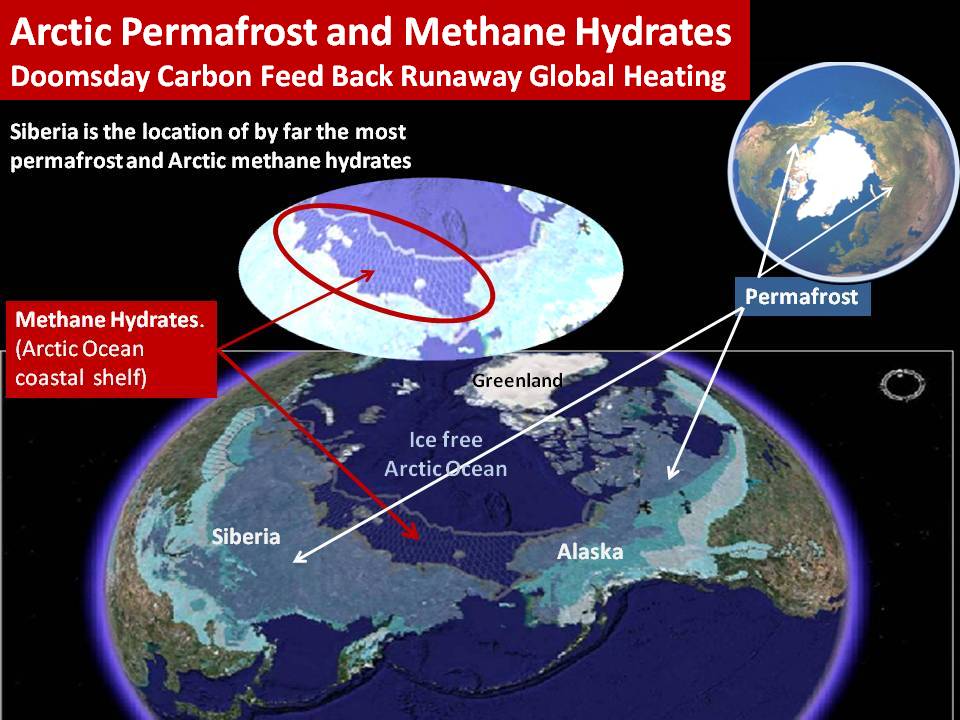
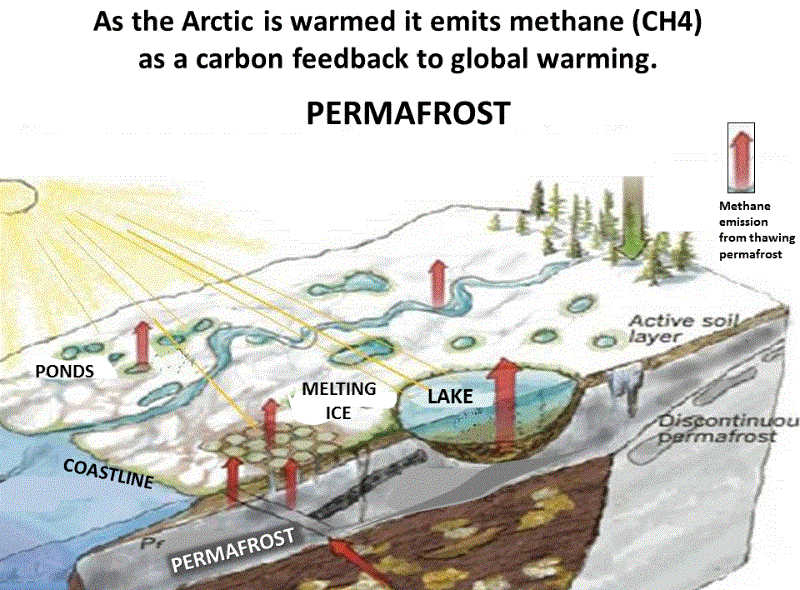
The rapidly warming Arctic has already been leaking methane from both thawing terrestrial permafrost for many years (global surface warming) and sub sea methane hydrates (some times called ocean floor permafrost) for several years (ocean warming and surface warming).
The methane emissions from thawing permafrost is the result of bacteria in the presence of water digesting the thawed soil carbon and emitting methane. So its slow process that happens some years after a level of permafrost is thawed.
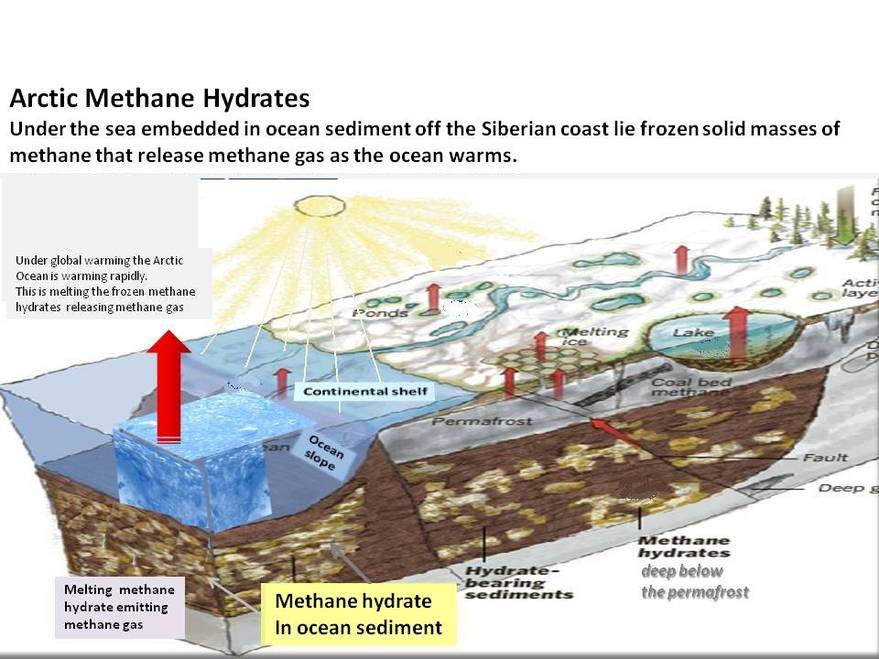
Methane hydrate on the other hand is pure methane that forms under conditions of cold and pressure. If pressure is reduced or temperature increased sufficiently, the methane is released and bubbles up through the sea water and from the East Siberian Arctic shelf, it is actually venting to the atmosphere. As the methane gas has over 100 times the volume of the solid hydrate it can release explosively. Methane hydrates are widely distributed around all continental coastal shelves but are most vulnerable to global warming in the Arctic.
In the Arctic, they are most vulnerable to global warming because they have formed nearer the ocean surface level in coastal sediments. They are also potentially vulnerable on the sea bed off the Siberian coastal shelf where the solid methane hydrate caps methane gas below the sea bed.
The methane emissions from thawing permafrost is the result of bacteria in the presence of water digesting the thawed soil carbon and emitting methane. So its slow process that happens some years after a level of permafrost is thawed.
Methane hydrate on the other hand is pure methane that forms under conditions of cold and pressure. If pressure is reduced or temperature increased sufficiently, the methane is released and bubbles up through the sea water and from the East Siberian Arctic shelf, it is actually venting to the atmosphere. As the methane gas has over 100 times the volume of the solid hydrate it can release explosively. Methane hydrates are widely distributed around all continental coastal shelves but are most vulnerable to global warming in the Arctic.
In the Arctic, they are most vulnerable to global warming because they have formed nearer the ocean surface level in coastal sediments. They are also potentially vulnerable on the sea bed off the Siberian coastal shelf where the solid methane hydrate caps methane gas below the sea bed.
The higher the global average temperature rises the greater will be the additional carbon emissions from the planet's carbon feedback response to global warming.
Carbon feedbacks will add more carbon to industrial greenhouse gas emissions and as temperatures rise further carbon feedback emissions will add increasingly more carbon. This should be a major consideration in zero carbon mitigation planning.
Carbon feedback is terribly dangerous. It can change the global climate change situation to one we could mitigate into one totally beyond our control.
Runaway
Carbon feedback is the cause of so-called runaway' global warming and climate change.
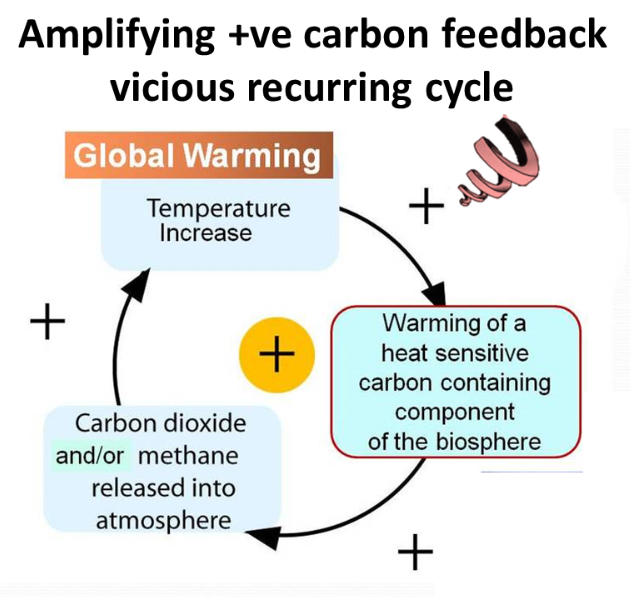
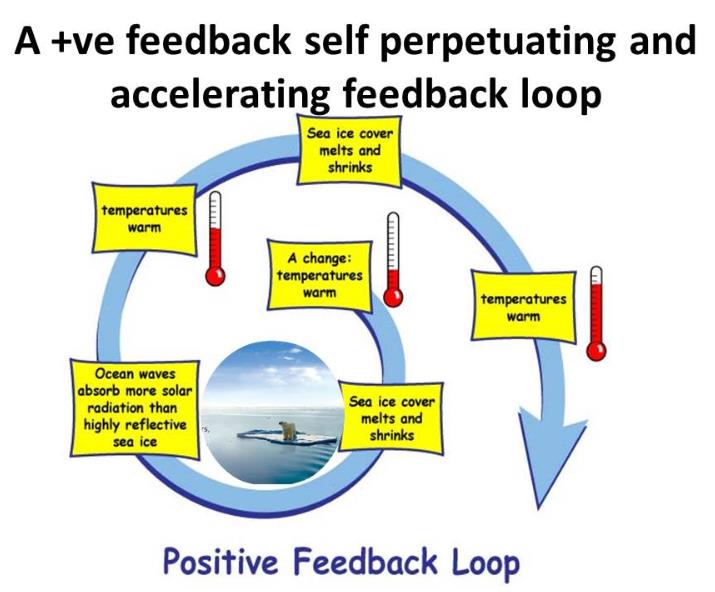
It is the ultimate vicious cycle.
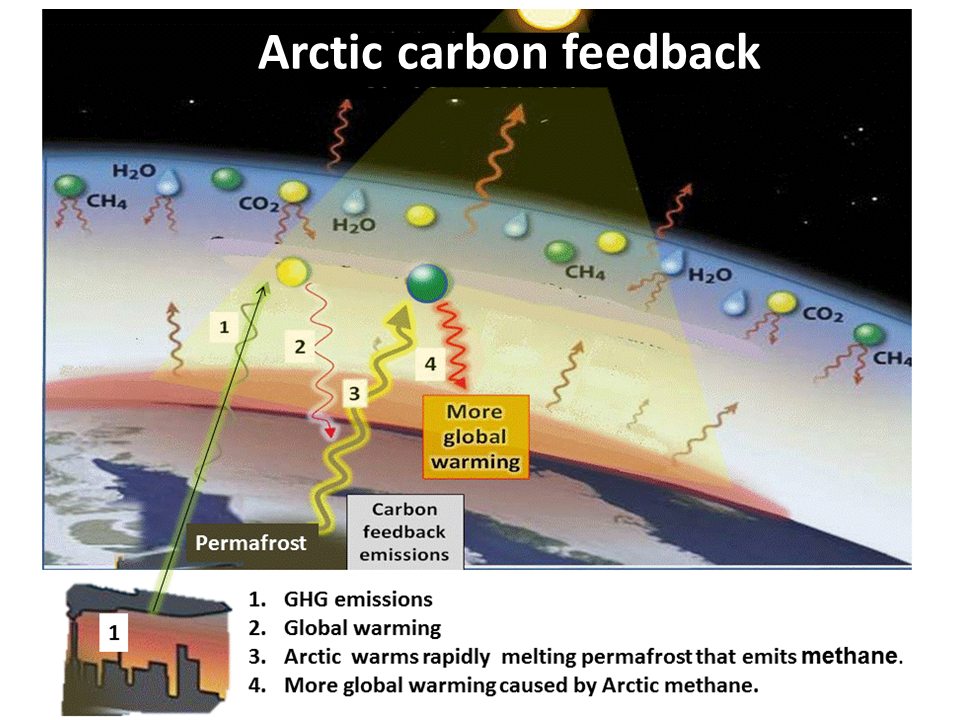
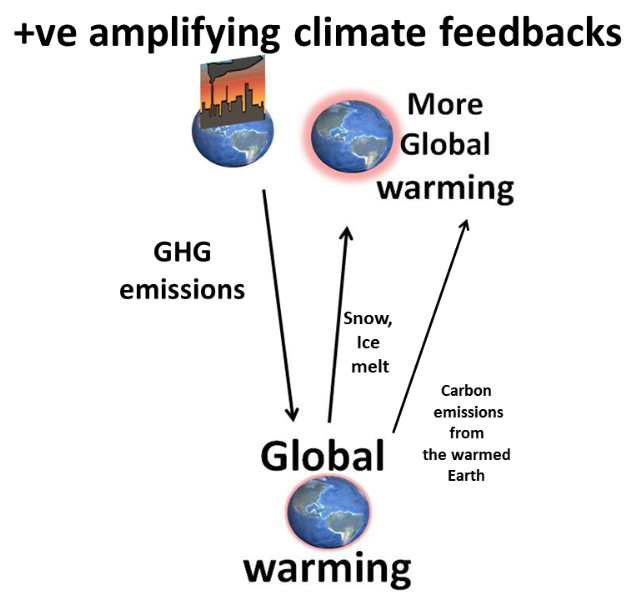
Industrial GHG emissions- cause global warming- that leads to feedback emissions- that increases global warming- that leads to even more feedback emissions etc etc.
It does not take long for feedback carbon emissions to make it impossible to get close to zero carbon emissions.
Carbon feedback is terribly dangerous. It can change the global climate change situation to one we could mitigate into one totally beyond our control.
Runaway
Carbon feedback is the cause of so-called runaway' global warming and climate change.
It is the ultimate vicious cycle.
Industrial GHG emissions- cause global warming- that leads to feedback emissions- that increases global warming- that leads to even more feedback emissions etc etc.
It does not take long for feedback carbon emissions to make it impossible to get close to zero carbon emissions.
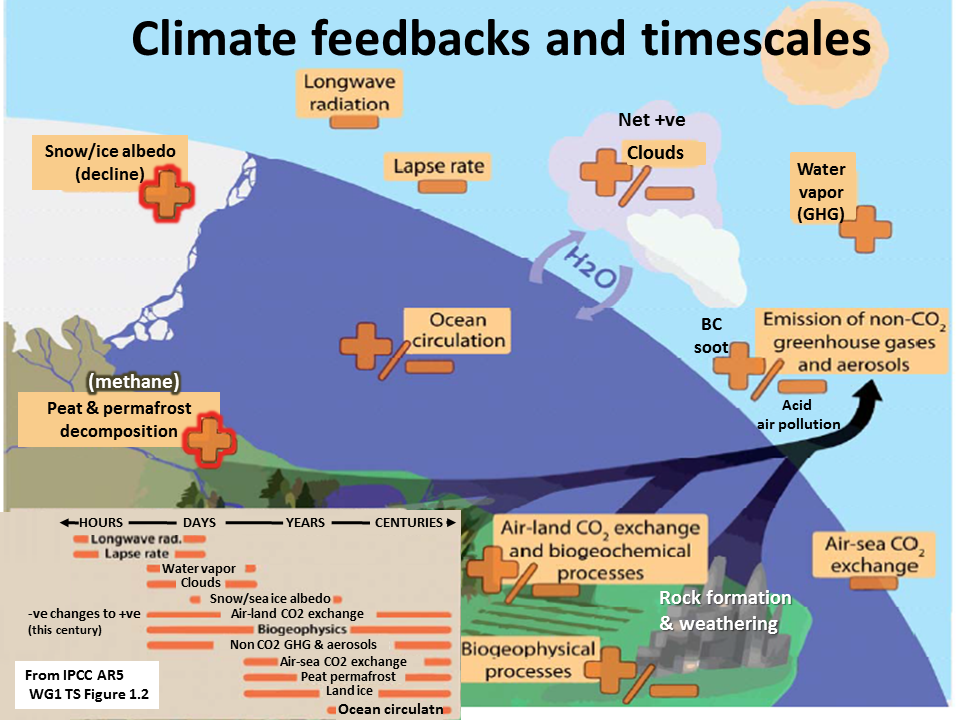
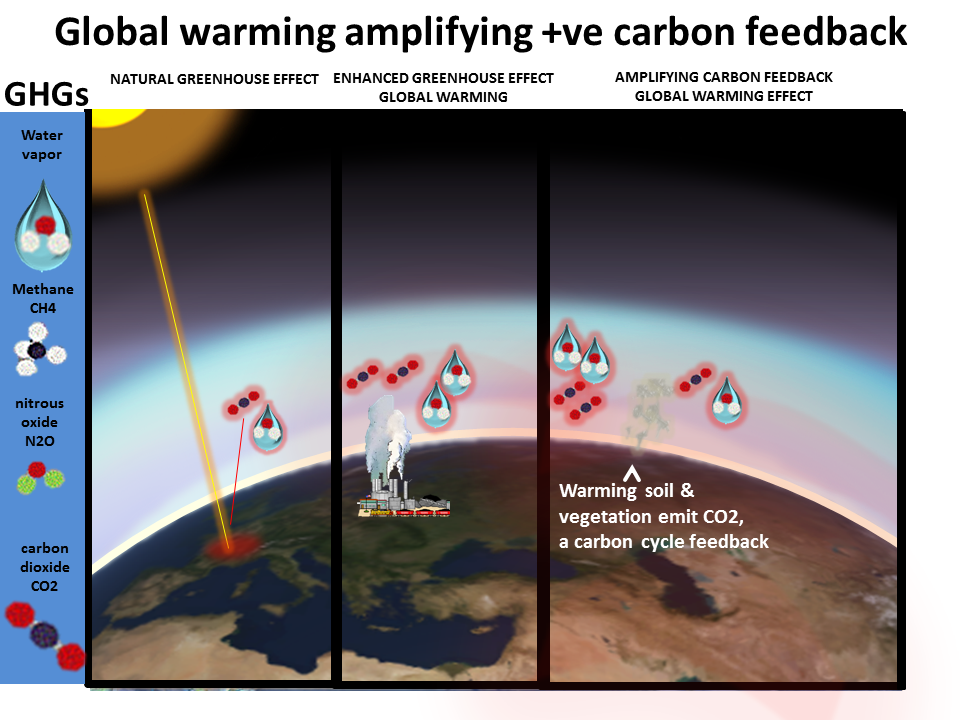
There are many carbon feedbacks and they are feeding back more carbon GHGs (CO2 carbon dioxide, CH4 methane) to the atmosphere from all the feedback sources already.
Positive (bad) carbon feed backs are a source of carbon emissions that must be taken into account for zero carbon emissions.
If we delay launching a global zero carbon emergency response any longer - no matter what we try to do, it will make no difference because multiple positive feedbacks will be irreversible and uncontrollable. We are in a race against time .
Positive (bad) carbon feed backs are a source of carbon emissions that must be taken into account for zero carbon emissions.
If we delay launching a global zero carbon emergency response any longer - no matter what we try to do, it will make no difference because multiple positive feedbacks will be irreversible and uncontrollable. We are in a race against time .
Arctic carbon feedbacks
The most dangerous effect of global warming is carbon feedbacks and the most dangerous of the carbon feedbacks by far is the carbon feedback from the Arctic.
The Arctic permafrost contains twice as much carbon as in the atmosphere. Most of this is emitted as methane (CH4) as the Arctic warms rapidly due to global warming.
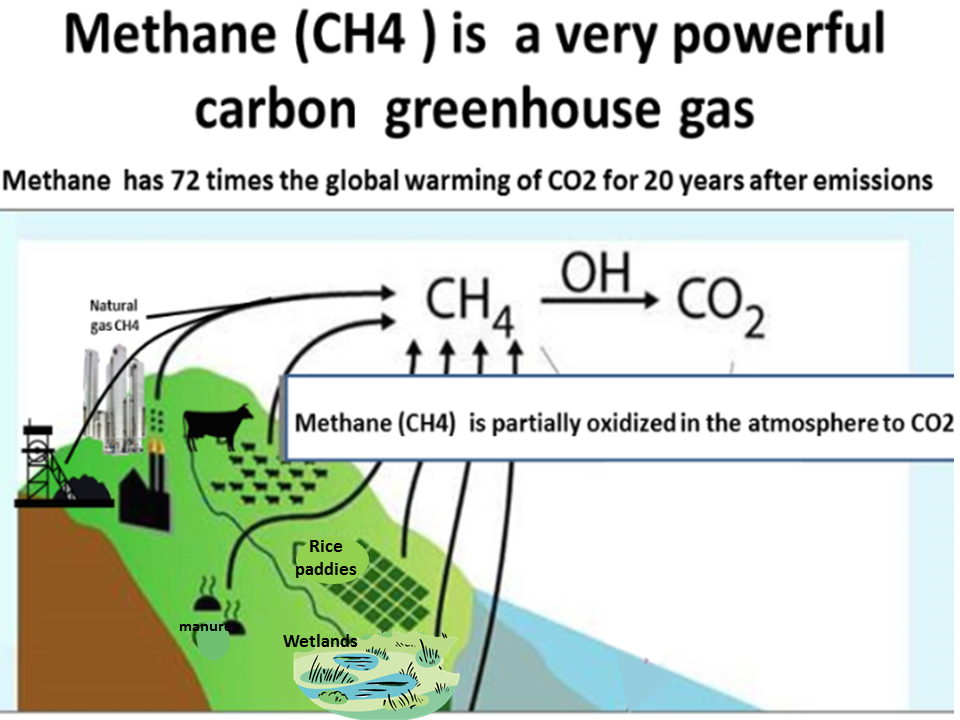
Methane only lasts in the atmosphere as methane for 12 years as by then it disappears because it's oxidized in the atmosphere to other greenhouse gases- notably including carbon dioxide, making methane feed back emissions a carbon dioxide source.
Massive Arctic methane carbon feedbacks is the greatest present threat to the survival of life on Earth as this is the potential cause of very rapid global warming and runaway global climate change.
The Arctic permafrost contains twice as much carbon as in the atmosphere. Most of this is emitted as methane (CH4) as the Arctic warms rapidly due to global warming.
Methane only lasts in the atmosphere as methane for 12 years as by then it disappears because it's oxidized in the atmosphere to other greenhouse gases- notably including carbon dioxide, making methane feed back emissions a carbon dioxide source.
Terrestrial carbon
feedback.
'Terrestrial' carbon feed back is CO2 or methane emitted by warmed living soils and decaying vegetation.
'Terrestrial' carbon feed back is CO2 or methane emitted by warmed living soils and decaying vegetation.
Peat-land and Arctic carbon are not included in terrestrial carbon by climate change science
As soil warms the microorganisms become more active emitting more CO2. As more vegetation dies from global warming more CO2 is emitted. The largest potential terrestrial feedback is the die-back of the planet's remaining large forested regions, notably the Amazon.
The additional carbon dioxide emitted by terrestrial carbon feedback according to the IPCC (2007) will be more than 1.0C by 2100- if we continue to do nothing.
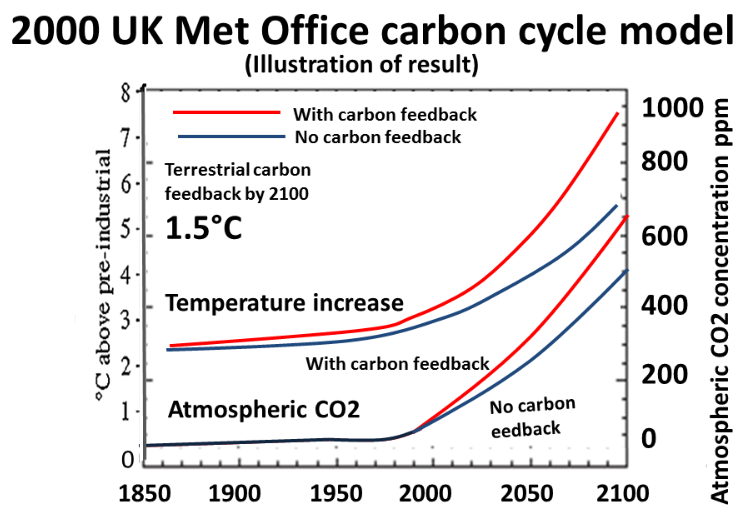
Since a 2000 paper by Peter Cox (Acceleration of global warming due to carbon-cycle feedbacks) , the upper range of terrestrial carbon projected warming is 1.5C by 2100. Other researchers calculate it as low as 0.5C by 2100. The difference is mainly due to the Cox model predicting the dieback of the Amazon forest by drying drought and fire.
The latest 2012 terrestrial carbon feedback research by B. Both (High sensitivity of future global warming to land carbon cycle processes) projects it to be high at 1.7C.
Since a 2000 paper by Peter Cox (Acceleration of global warming due to carbon-cycle feedbacks) , the upper range of terrestrial carbon projected warming is 1.5C by 2100. Other researchers calculate it as low as 0.5C by 2100. The difference is mainly due to the Cox model predicting the dieback of the Amazon forest by drying drought and fire.
The latest 2012 terrestrial carbon feedback research by B. Both (High sensitivity of future global warming to land carbon cycle processes) projects it to be high at 1.7C.
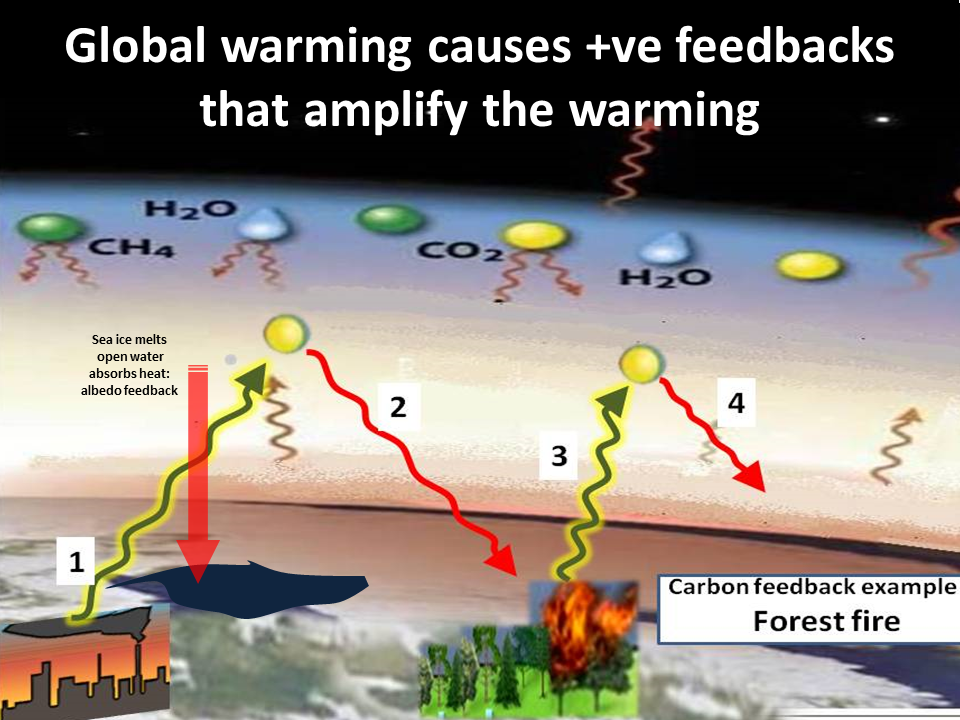
Already on the many continents that increased forest fires as a result of global warming.
The fossil fuels are burnt to produce fossil fuel energy and in doing so they emit carbon dioxide that causes global warming. The burning forest fires also emit carbon dioxide which then adds to the global warming.
The fossil fuels are burnt to produce fossil fuel energy and in doing so they emit carbon dioxide that causes global warming. The burning forest fires also emit carbon dioxide which then adds to the global warming.
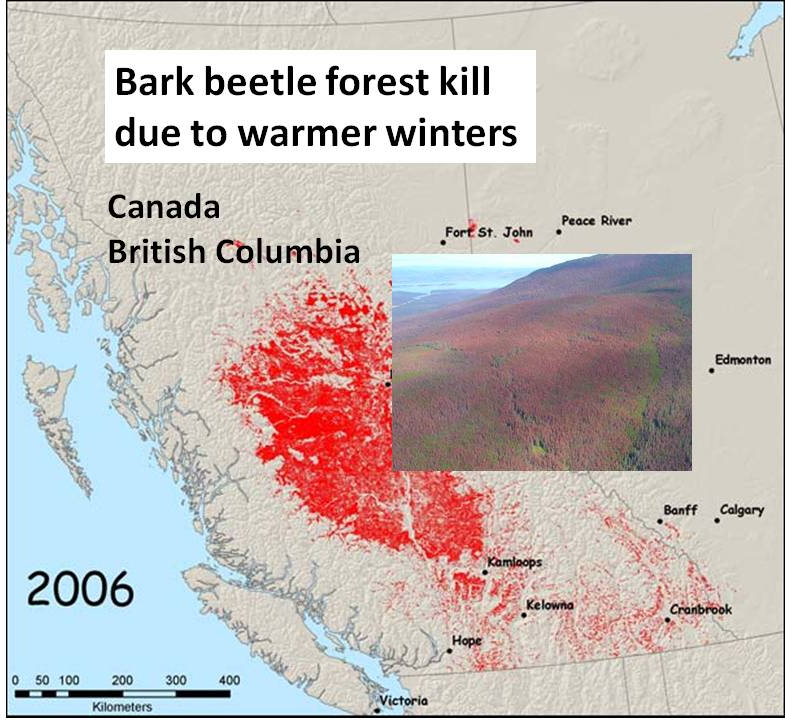
There is another example for carbon feedback from dying forests. This one is caused by increased insect infestation of forest trees under warmer temperatures. As the trees die they stop absorbing CO2 and the forests emit a lot of carbon dioxide released by the dying trees.
More drying, more heat waves, more toxic ground level ozone
more insect infestation and more diseases combined together will result in large forested regions of the planet burning away under increasing global warming.
More drying, more heat waves, more toxic ground level ozone
more insect infestation and more diseases combined together will result in large forested regions of the planet burning away under increasing global warming.
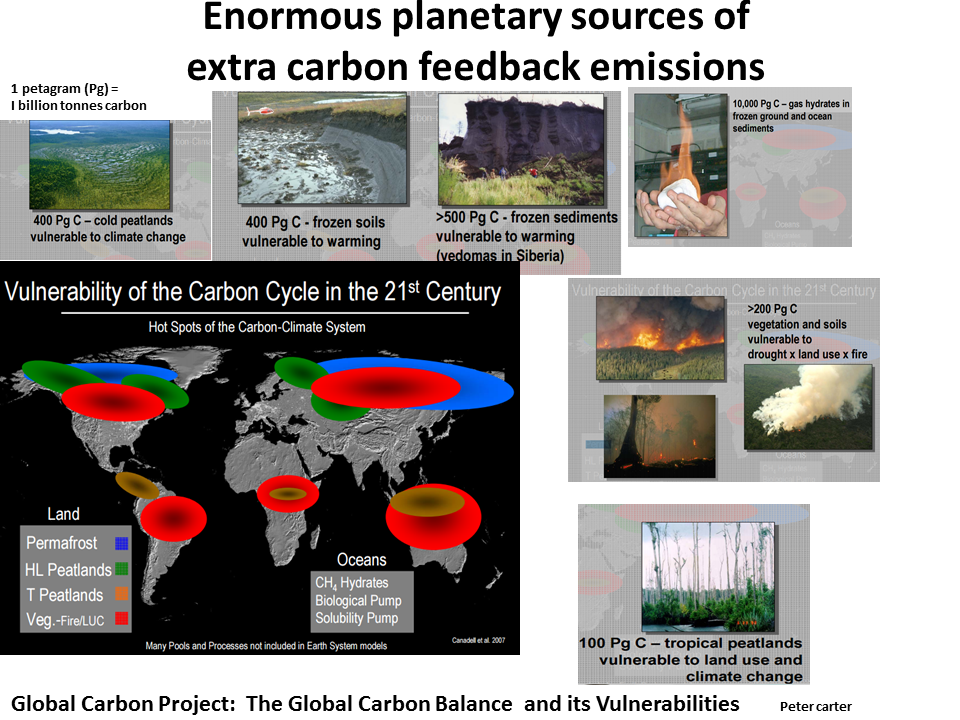
The most catastrophically dangerous effect of global warming (by definition) is the large number of potentially large 'positive' amplifying feedback responses to global warming.
Presently the land and oceans absorb ('sink' or rather store) about half of industrial carbon emissions, but that cannot last indefinitely. The sinks are not permanent, but will both weaken over time. This has probably started already( Raupach July 2014).
There are very large planetary sources of positive amplifying feedbacks, whereby global warming causes the planet to increase the warming further.
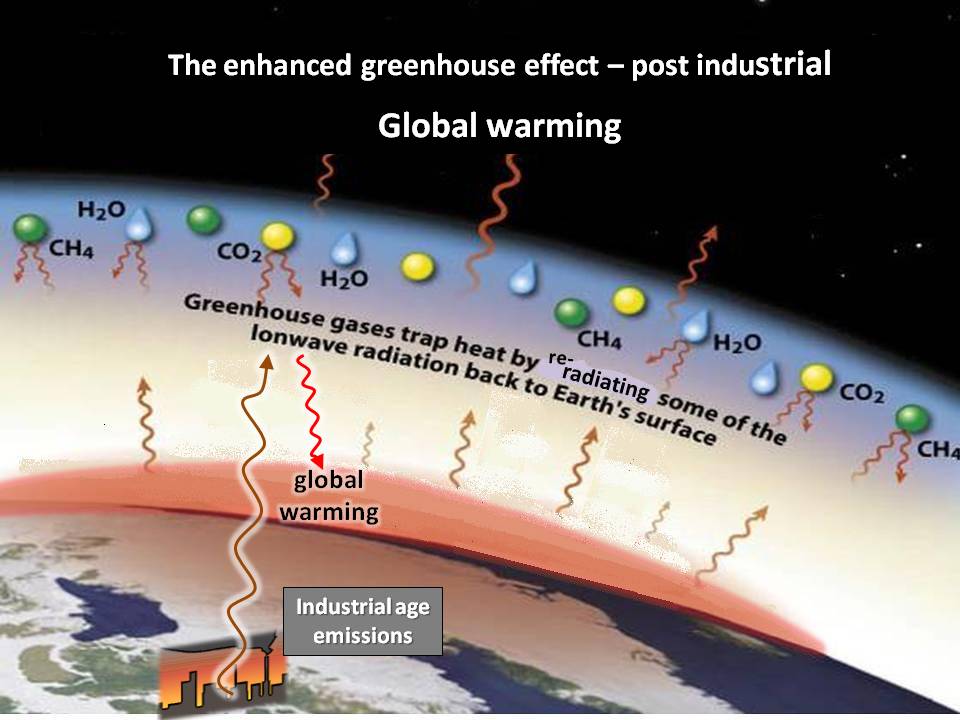
Increase atmospheric CO2 and increased global temperature may lead to positive carbon feedback adding the warming.
Land changes and ocean changes may lead to positive carbon feedbacks.
There are very many sources of carbon feedback.
Carbon feedback is a crucial intrinsic part of the
climate system.
We may think of planetary carbon emissions as
balanced by carbon uptake- by the photosynthesis of
green plants, on land and sea. Ocean surface plankton
take up the most CO2.
Presently the land and oceans absorb ('sink' or rather store) about half of industrial carbon emissions, but that cannot last indefinitely. The sinks are not permanent, but will both weaken over time. This has probably started already( Raupach July 2014).
There are very large planetary sources of positive amplifying feedbacks, whereby global warming causes the planet to increase the warming further.
Increase atmospheric CO2 and increased global temperature may lead to positive carbon feedback adding the warming.
Land changes and ocean changes may lead to positive carbon feedbacks.
There are very many sources of carbon feedback.
Carbon feedback is a crucial intrinsic part of the
climate system.
We may think of planetary carbon emissions as
balanced by carbon uptake- by the photosynthesis of
green plants, on land and sea. Ocean surface plankton
take up the most CO2.
Carbon feedbacks by planetary source
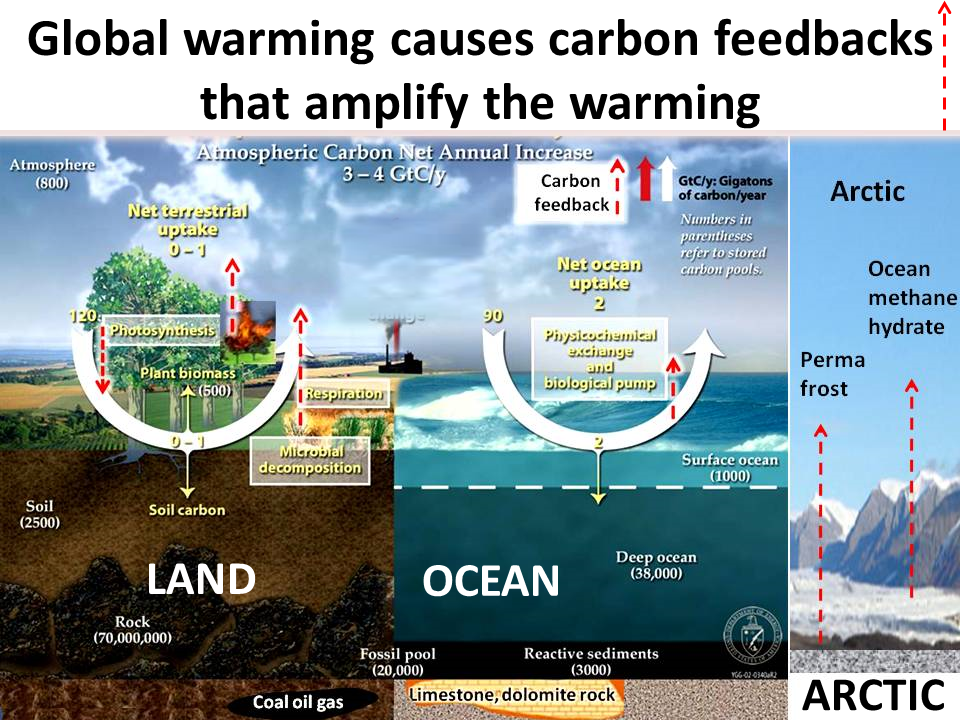
This illustration of the perturbed carbon cycle, shows three planetary general sources of carbon feedback emissions.
From left to right we have: Terrestrial- Ocean-Arctic
Terrestrial feed backs
o Increased decomposition and respiration by soil organisms in a warming soils.
o Extreme weather events- reduce carbon uptake by green vegetation photosynthesis. This is caused by heat waves and drought.
o Increased green plant toxic ground level ozone increase- reduced photosynthesis.
o Increased forest fires - emit black carbon, CO2 and methane.
Ocean carbon feed backs.
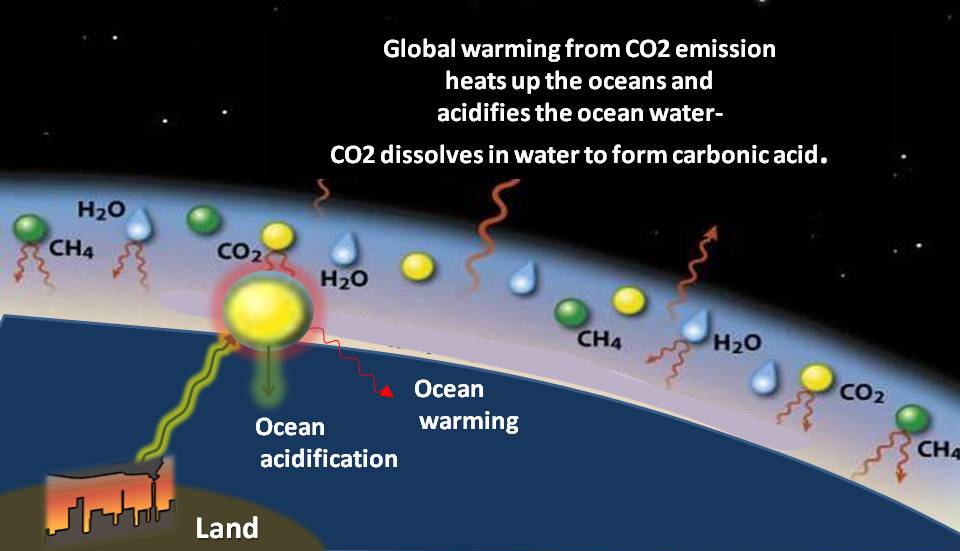
o Increased water temperature dissolves less CO2.
o Increased ocean acidification dissolves less CO2.
o Reduced phytoplankton growth reduces ocean photosynthesis.
o Impaired Capacity of shell bearing organization to make calcium carbonate.
Arctic cryosphere carbon feedbacks
o Thawing permafrost
o Melting ocean floor methane hydrates
From left to right we have: Terrestrial- Ocean-Arctic
Terrestrial feed backs
o Increased decomposition and respiration by soil organisms in a warming soils.
o Extreme weather events- reduce carbon uptake by green vegetation photosynthesis. This is caused by heat waves and drought.
o Increased green plant toxic ground level ozone increase- reduced photosynthesis.
o Increased forest fires - emit black carbon, CO2 and methane.
Ocean carbon feed backs.
o Increased water temperature dissolves less CO2.
o Increased ocean acidification dissolves less CO2.
o Reduced phytoplankton growth reduces ocean photosynthesis.
o Impaired Capacity of shell bearing organization to make calcium carbonate.
Arctic cryosphere carbon feedbacks
o Thawing permafrost
o Melting ocean floor methane hydrates
Ocean carbon feedbacks
Carbon cycle feedback
As the land is warmed, it becomes a source of additional carbon emissions as carbon dioxide
(CO2) or as methane (CH4) emissions. This effect is called carbon feedback.
Methane is a powerful GHG and some
of it is converted to CO2 in the
atmosphere by chemical reaction.
Carbon feedbacks, excluding the largest carbon stores of peat, Arctic permafrost sub seafloor methane gas, are called terrestrial carbon cycle feedback.
Terrestrial carbon feedback warming by 2100 is estimated as high as 1.8C (Booth 2012).
Peat and Arctic carbon feedbacks containing by far the most planetary carbon could easily be in the same range.
As the land is warmed, it becomes a source of additional carbon emissions as carbon dioxide
(CO2) or as methane (CH4) emissions. This effect is called carbon feedback.
Methane is a powerful GHG and some
of it is converted to CO2 in the
atmosphere by chemical reaction.
Carbon feedbacks, excluding the largest carbon stores of peat, Arctic permafrost sub seafloor methane gas, are called terrestrial carbon cycle feedback.
Terrestrial carbon feedback warming by 2100 is estimated as high as 1.8C (Booth 2012).
Peat and Arctic carbon feedbacks containing by far the most planetary carbon could easily be in the same range.
Carbon dioxide emissions due to carbon feed back is a additional source of carbon and as such should be accounted for in zero carbon climate change mitigation.
Peatlands and permafrost
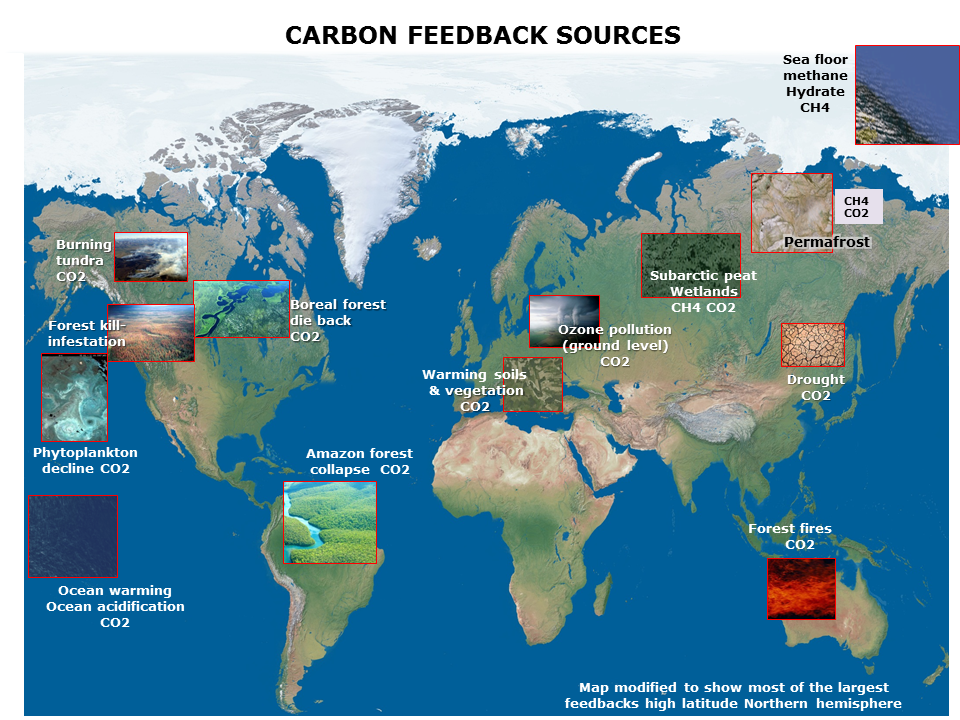
Carbon from warming peatlands (Arctic and tropical), and from thawing permafrost (permanently frozen soils in the Arctic) is emitted mainly as methane and some CO2. Neither are included among the terrestrial carbon feedbacks and These sources hold double of all the carbon in the atmosphere.
Arctic methane hydrate carbon (frozen solid methane gas) in the ocean floor sediment of the Arctic
is already being released into the ocean and from the East Siberian Arctic shelf it is bubbling up to
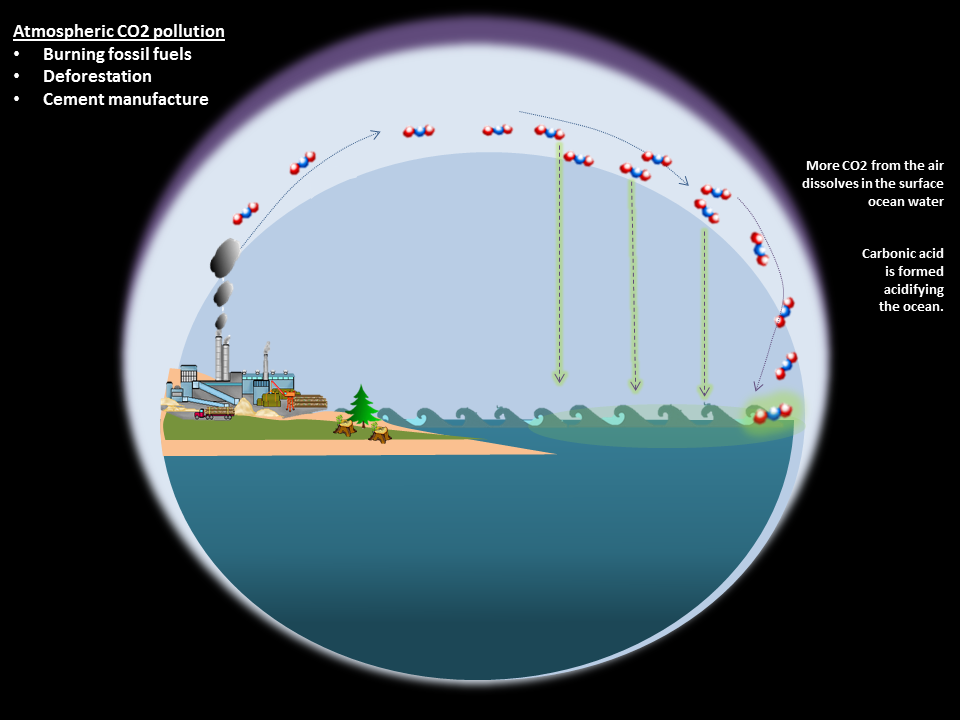
emit methane into the atmosphere. Methane released into the ocean will add to ocean acidification.
This is double the carbon in the atmosphere
Oceans absorbing less CO2
Warm water dissolve less atmospheric CO2 than cold water.
Acidified ocean water will absorb less CO2.
Carbon from warming peatlands (Arctic and tropical), and from thawing permafrost (permanently frozen soils in the Arctic) is emitted mainly as methane and some CO2. Neither are included among the terrestrial carbon feedbacks and These sources hold double of all the carbon in the atmosphere.
Arctic methane hydrate carbon (frozen solid methane gas) in the ocean floor sediment of the Arctic
is already being released into the ocean and from the East Siberian Arctic shelf it is bubbling up to
emit methane into the atmosphere. Methane released into the ocean will add to ocean acidification.
This is double the carbon in the atmosphere
Oceans absorbing less CO2
Warm water dissolve less atmospheric CO2 than cold water.
Acidified ocean water will absorb less CO2.
Forests
Forest fires are already increasing under global warming and are a carbon feedback emitting mainly carbon dioxide as they burn but also methane.
Forest insect infestations increase under global warming so this is +ve feedback by killing forests.
Forest fires are already increasing under global warming and are a carbon feedback emitting mainly carbon dioxide as they burn but also methane.
Forest insect infestations increase under global warming so this is +ve feedback by killing forests.
Arctic frozen solid methane hydrates under the ocean floor, which also hold possibly up twice as much carbon as the atmosphere.
(Soil organic carbon pools in the northern circumpolar permafrost region C. Tarnocai J. G. Canadell et al 27 June 2009)
The far north and Arctic have been warming up twice as faster than the rest of the planet In Siberia , that holds by far the most of the Arctic's huge store of frozen carbon, some regions have been warming three times as fast. This is all much faster than the scientists had predicted from their computer models and the Arctic is now warming four times as fast as the rest of the planet.
(Soil organic carbon pools in the northern circumpolar permafrost region C. Tarnocai J. G. Canadell et al 27 June 2009)
The far north and Arctic have been warming up twice as faster than the rest of the planet In Siberia , that holds by far the most of the Arctic's huge store of frozen carbon, some regions have been warming three times as fast. This is all much faster than the scientists had predicted from their computer models and the Arctic is now warming four times as fast as the rest of the planet.
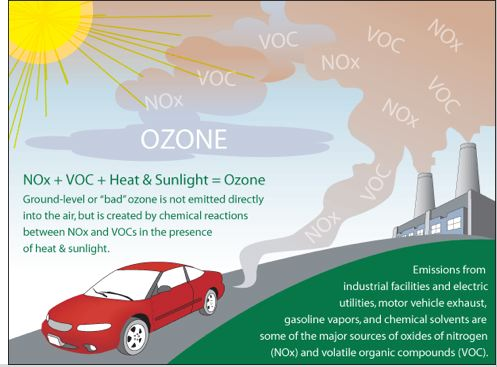
Tropospheric (ground level) ozone is projected to be the cause of a major carbon feedback with further global warming. Ground level ozone is well known to be toxic to human health and it is also toxic to green plants reducing their capacity for capturing carbon from the air by photosynthesis. This ozone air pollution is formed by a chemical reaction from fossil fuel pollutants and the reaction is catalyzed by the warmth of sunlight. Therefore this toxic ground level ozone will increase with global warming, and plants will become less efficient at fixing carbon from the ambient carbon dioxide, leaving more carbon dioxide in the air- a positive amplifying carbon feedback.
Extreme weather events that are increasing is a source of carbon feedback, because the capacity of the damaged vegetation to take up CO2 is impaired (Climate extremes and the carbon cycle
M Reichstein
Nature 2013) terrestrial ecosystems absorb approximately 11 billion tons less carbon dioxide every year as the result of the extreme climate events. That is equivalent to approximately a third of global CO2 emissions per year.

Recent research
March2014 Amazon rainforest ability to soak up CO2 is falling.
July 2014 Mike Raupach The declining uptake rate of atmospheric CO2 by land and ocean sinks.
2012 B Booth et al High sensitivity of future global warming to land carbon cycle processes projects warming of 7.8C 2100.
March2014 Amazon rainforest ability to soak up CO2 is falling.
July 2014 Mike Raupach The declining uptake rate of atmospheric CO2 by land and ocean sinks.
2012 B Booth et al High sensitivity of future global warming to land carbon cycle processes projects warming of 7.8C 2100.